🛡️ Guardian
The AI agent with a leash. Presenter mode plays the full clinic story: ask, decide, approve, read, revoke, verify.
SKPods gives every person a Solid pod: one place on the web where their data lives, owned by them. Apps ask before they read. An AI guardian answers for you, under your rules, and every yes comes with an expiry date.
The web was built so anyone could publish. Then data moved into a few giant databases, and every app kept its own copy of you. Solid, started by Sir Tim Berners-Lee (who invented the web), flips that around. You get a pod: a personal data store with a web address. Apps stop hoarding your data. They come to your pod, ask for exactly what they need, and you can say no, or say yes until Friday.
A small web server for your stuff: files and structured data (your allergies, your receipts, your contacts) in open formats any app can read.
One web address that is your identity. You log in to apps with it, the same way everywhere, and no single company owns your login.
Every folder has a permission list. You decide who reads, who writes, who can only drop things off. Take it back and the door closes.
No. A drive stores files for you to open. A pod stores data that apps can understand and use with your permission. A clinic app can read just your allergy list, for 72 hours, without seeing anything else in your pod.
No tokens, no chain, no wallet. Pods use ordinary web standards (HTTP, OpenID Connect, linked data), the same plumbing the rest of the web runs on. Our audit log uses hash chaining so tampering shows, which is just good bookkeeping.
Wherever you choose: on a server you run, with a provider you trust, or with us. Because Solid is an open standard, you can move your pod and every app keeps working. That is the point.
Honestly: nothing technical, once data has left your pod. What pods change is everything before that. Apps get only what you allow, only for as long as you allow, and there is a record of who read what and when. Businesses get a reason to stop keeping copies at all: they can read it from your pod next time.
Because most pod apps were hard to use and broke at login. The idea was right and the experience was not. That is the part we are fixing: apps that feel like apps, a guardian that handles the asking, and hosting that you can set up in an afternoon.
Your receipts, chats and records stay in your pod. Try a new app without starting over, and drop an old one without losing anything.
One screen shows every app and business with access to your data, what they can see, and when it ends.
Permissions expire on their own. "24 hours", "until the appointment ends". No more forever checkboxes.
Manage a child's pod until they are grown, or help an aging parent decide who sees their care log, as a named delegate.
Your agent acts on your behalf, under rules stored in your pod, not the platform's. It has a leash, and you hold it.
A clinic that reads intake data from your pod, instead of storing it, has less to leak, less to secure and less to explain.
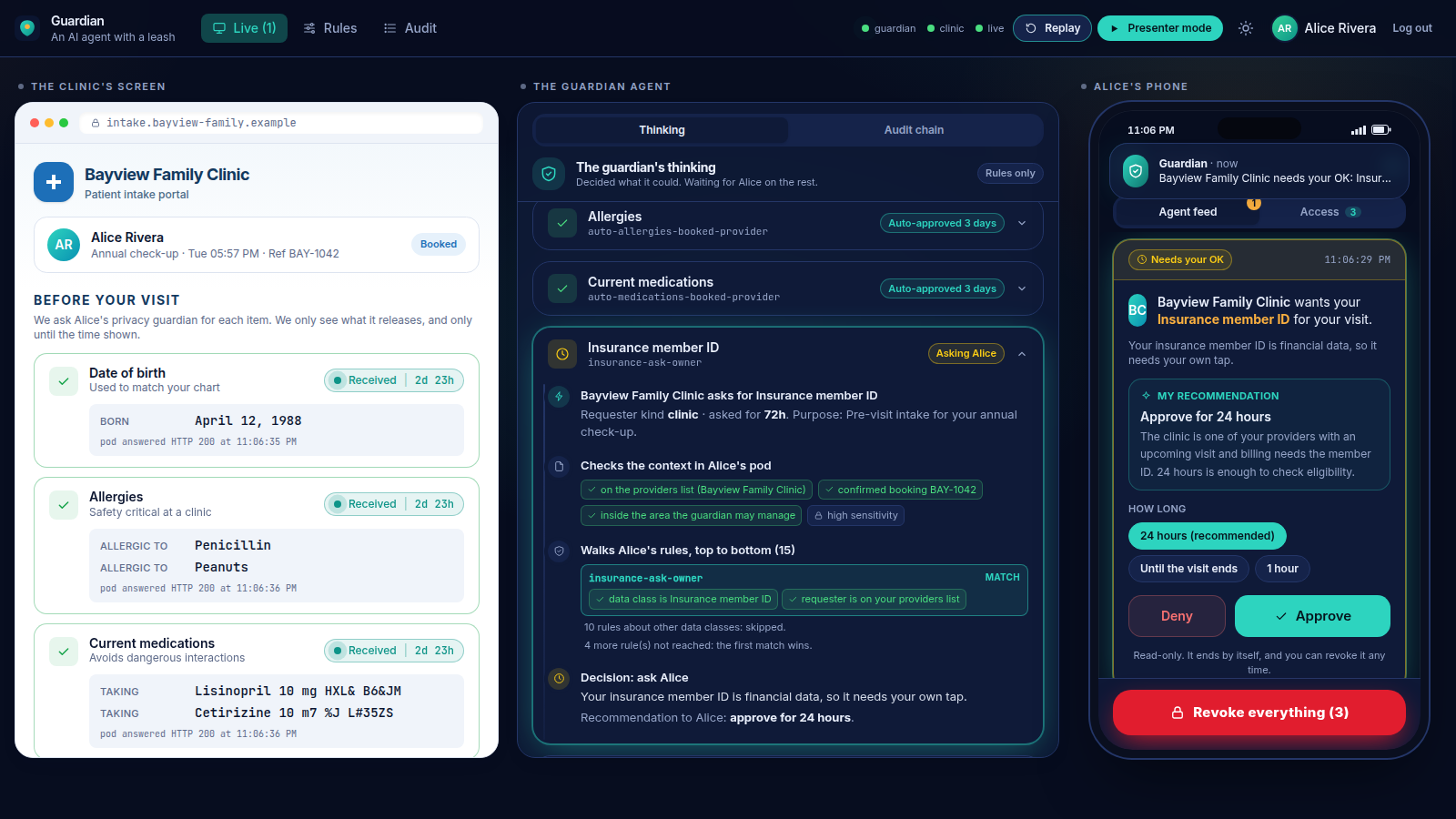
Bayview Family Clinic needs Alice's details before her check-up: date of birth, allergies, current medications, insurance member ID, and her Social Security number. Alice is busy. Her guardian agent answers, item by item, under the policy Alice wrote and keeps in her own pod. Watch it happen.
Bayview is in Alice's providers list and there is a confirmed booking. Basic health intake is fine, for 72 hours, then it switches off by itself.
rule: basic-health-booked-provider
Money touches this one, so it goes to Alice's phone with the agent's recommendation: "approve for 24 hours, it is a known provider with a booking". One tap.
rule: insurance-ask-owner
Never shared. The clinic gets a plain explanation and a counter offer: "use the insurance member ID instead". Nobody is left stuck.
rule: never-share-ssn
The guardian's policy is a JSON-LD document stored in the owner's pod. First match wins, no match means "ask the owner", and nothing outside the containers you delegated can ever be granted.
// skpods/v1/consents/policy.jsonld (shortened)
{ "@type": "GuardianPolicy", "ceiling": "30d",
  "rules": [
    { "id": "never-share-ssn", "dataClasses": ["ssn"],
      "action": "deny",
      "counterOffer": { "dataClass": "insurance_member_id" } },
    { "id": "basic-health-booked-provider",
      "dataClasses": ["dob", "allergies", "medications"],
      "when": { "requesterInProviders": true, "hasBooking": true },
      "action": "approve", "maxDuration": "72h" },
    { "id": "insurance-ask-owner",
      "dataClasses": ["insurance_member_id"],
      "action": "ask_owner",
      "recommend": { "action": "approve", "duration": "24h" } } ] }
The Solid permission system (Web Access Control) answers one question: may this identity do this, here, right now? It has no clock. So we built the part that remembers to take access back: the sk-consent broker, a small Rust service that writes permissions, removes them on time, and proves it did.
A business files a request: which data, why, for how long. The person (or their delegate) sees exactly that.
The guardian applies the owner's policy: approve with a cap, ask the owner, or deny with a reason and a counter offer.
A read-only permission is written on exactly that resource, for exactly that identity. Never the whole pod, never a group.
A sweeper checks every grant each second. Grants are persisted, so a restart still revokes on time.
Revoke is checked, not assumed: the broker reads the resource as the grantee and expects a refusal. If it is not refused, it retries.
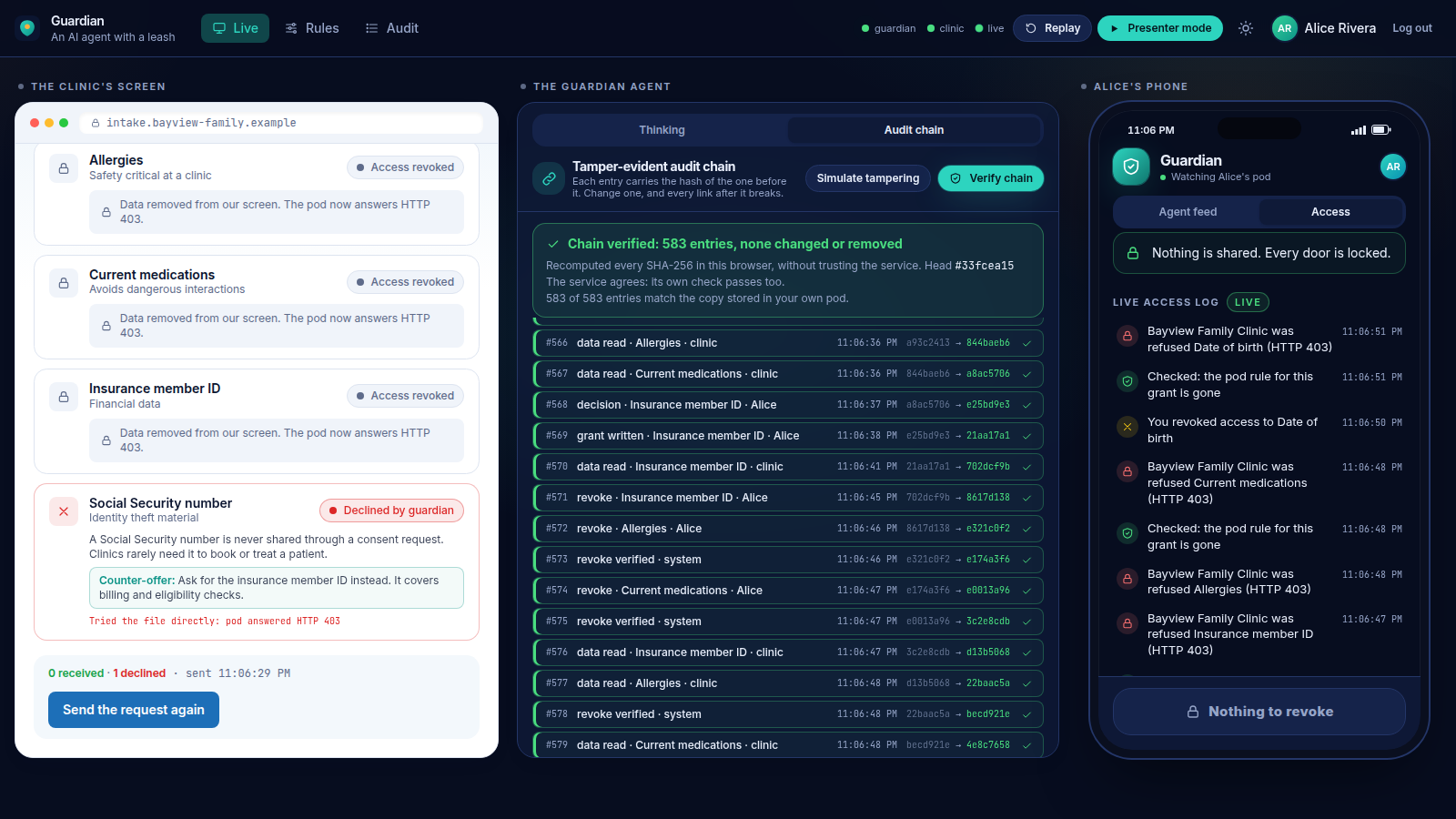
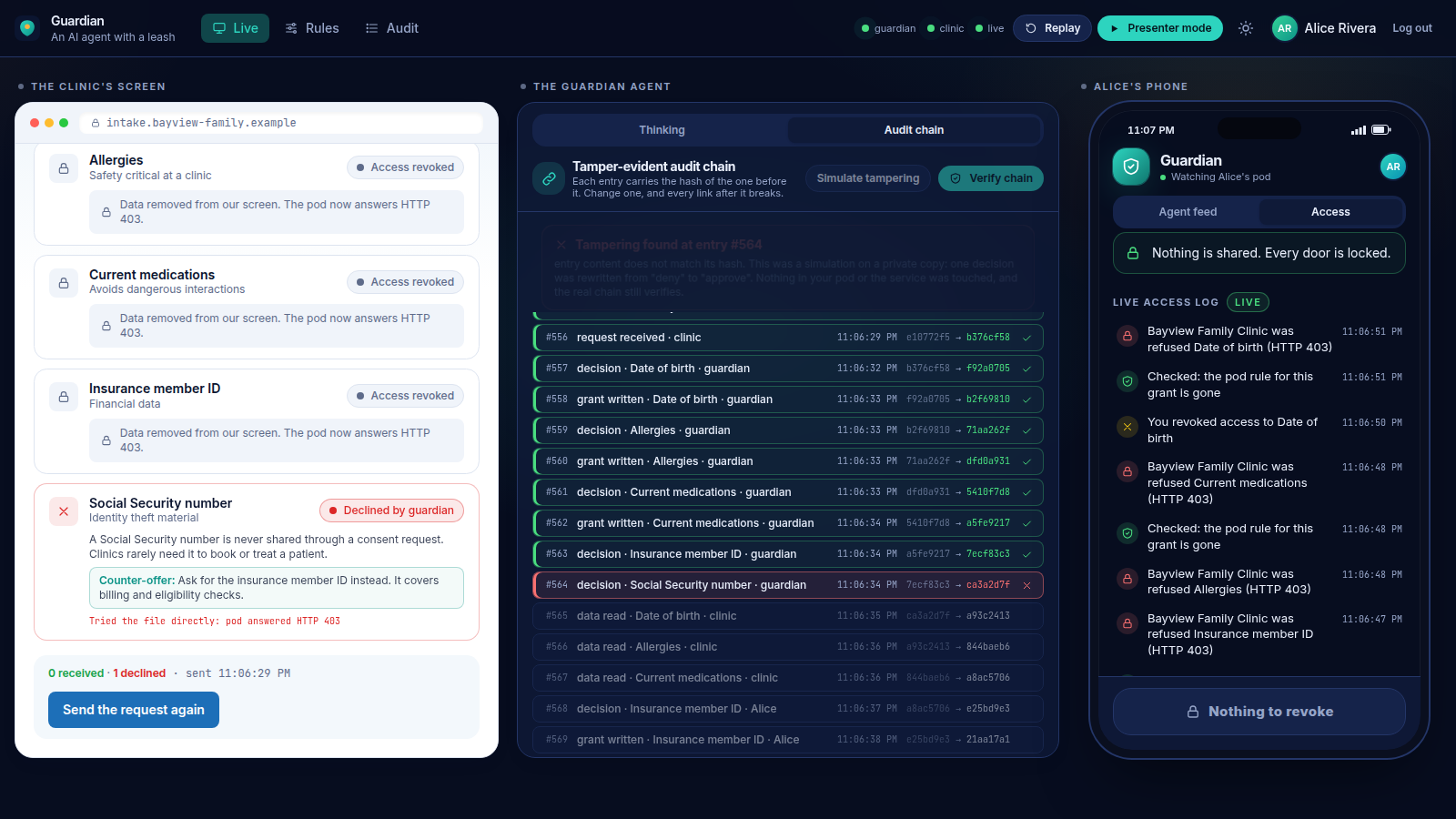
Every step lands on a hash-chained audit log, mirrored into the owner's pod, so they can verify it without trusting us.
The green ones run today against our dev server with fake data. The blue ones are designed, with the data model and access rules written down. The orange ones are where this goes next.
The clinic asks, your guardian answers, access ends after the visit. The clinic never stores your SSN because it never gets it.
A care facility asks to read Grandma's care log. Her daughter, the named delegate, approves for 24 hours. It switches off by itself, and the family sees every read.
Stores drop receipts into an append-only inbox in your pod. They can deliver, never read back. Warranty, taxes, expenses: all yours, across every shop.
Each person's messages live in their own pod. Leave a group and your messages leave with you, because they were never the app's.
Parents, kids and shared family data (schedules, school forms, medical cards) with group access, and a child's pod that grows up with them.
A shared space per customer and business that holds references, not copies. The business works with you without warehousing you.
The practice grants its own staff access by role, and the person's consent still bounds all of it.
Your agent's memories live in your pod, not a vendor's cloud. Switch AI providers and your agent still knows you. See the vision.
Docs, sheets, calendar, the works, running on rented compute, with every file saved to your pod. See the vision.
Most Solid apps are rough, half maintained, and break at login. We built four that are fast, honest about what they do, and pleasant to use, on desktop and phone, in light and dark. Each one logs in with real Solid-OIDC and reads real pod data, with an end-to-end test against the dev server.
The AI agent with a leash. Presenter mode plays the full clinic story: ask, decide, approve, read, revoke, verify.
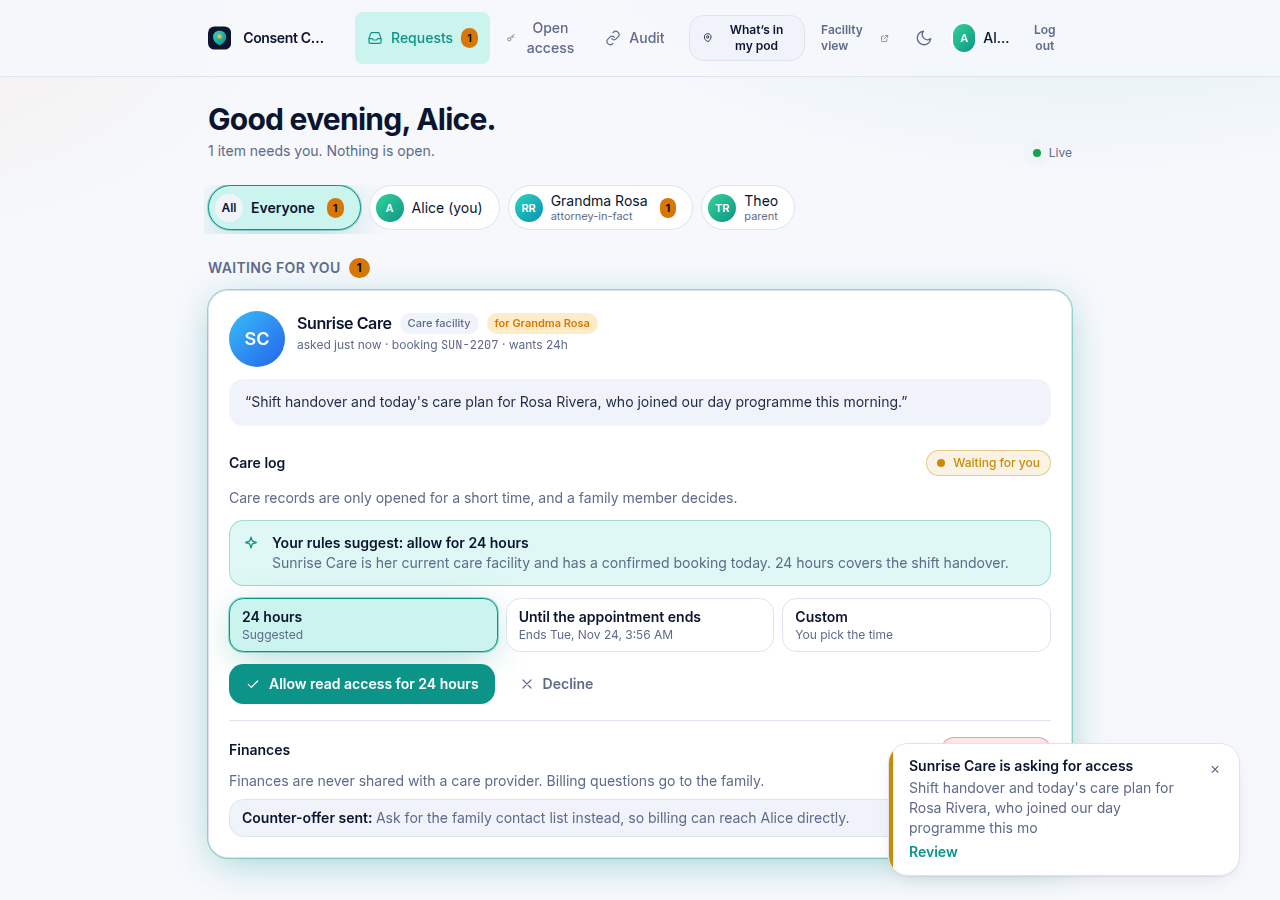
Every request for your data in one place. Approve with an expiry, watch grants count down and switch off, verify the audit chain.
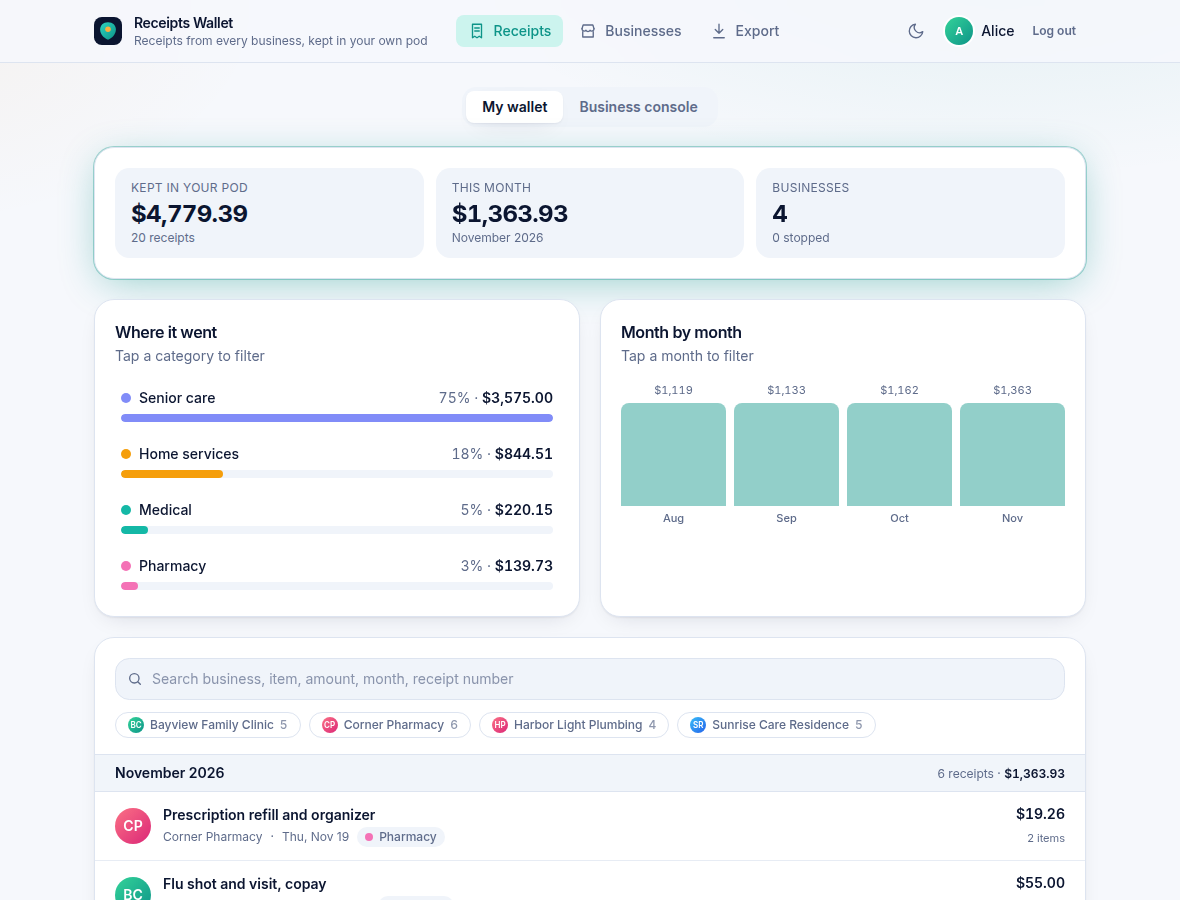
Businesses deliver to an append-only inbox in your pod. Search, totals, export, and it all comes with you when you switch providers.
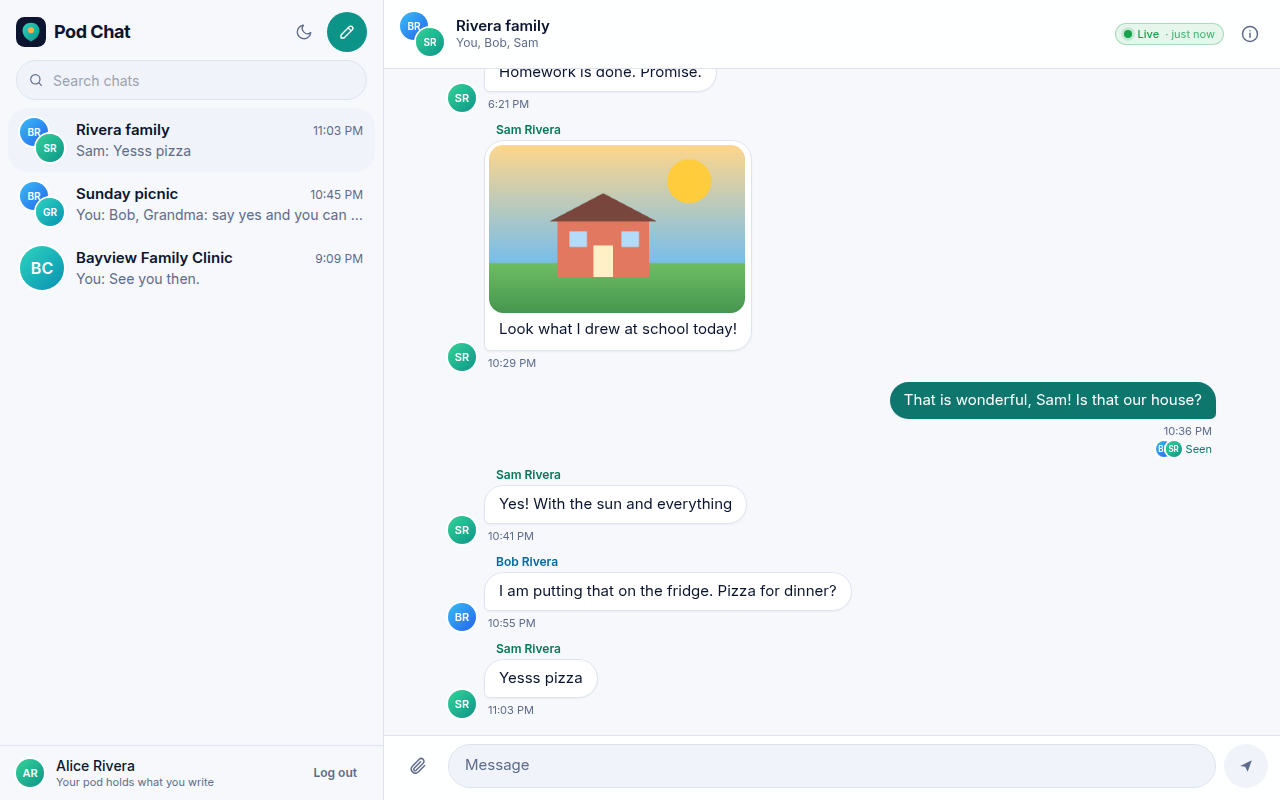
A conversation assembled from everyone's pods. Leave the chat and your messages vanish for everyone, because they were always yours.
No proprietary pod API, no lock-in. Apps speak plain Solid over HTTP with DPoP-bound tokens through one small interface (PodStore). The engine underneath can change without any app noticing, and only does so after passing the same conformance gate.
Policies, requests, grants and audit entries are linked data in https://w3id.org/skpods/v1#, reusing schema.org, vCard, FOAF and Solid terms first. Any app, and any other pod provider, can read a person's consents without our software. The path forward is the W3C access request and grant work and ACP, and the model is shaped to move there.
Every engine behaviour apps must design around is written down with the exact request and response, from missing ETags to how patches apply. We mark every feature as Working, Designed or Planned, and the status table below is the real one.
Once data lives in pods, an app stops being a place where your data is kept. It becomes compute that visits your data. That split changes what a service provider is.
Picture a Nextcloud with real office tools (documents, spreadsheets, calendar, contacts) where your files are not on that server at all. You log in with your WebID. The server lends you CPU and RAM and the editors. Every save goes straight to your pod. Close your account and nothing is left behind, because nothing was ever kept there.
What it takes: a pod storage backend for Nextcloud's files layer and WebID login. The pod engine needs change detection (ETags) first, which the Rust engine is designed to provide. Calendars and contacts need their own mapping. The server still sees your data while it is working on it, so you choose a provider you trust for compute, and you can switch providers any time.
Your agent's memories, preferences and history live in your pod. Any AI runtime you allow can read them, build its search index on the spot, and throw that index away when it is done. Switch providers and your agent still knows you. Revoke a provider and it forgets you, for real.
Why it fits: SKMemory already keeps memories as plain files and treats every search index as derived and rebuildable. Point the files at a pod and the architecture holds. The guardian decides which agent may read which memories, and for how long.
Pod hosting has a reputation for being fiddly. Ours is one Ansible role with one engine setting, built by our CI and pinned by digest. Deploy it next to the rest of your stack, or let us run it.
Your servers, your pods, free forever
Coming soon: we run it, you own it
Your app, their data, their rules
@skpods/solid-web: login, DPoP fetch, PodStore, access helpers.# self-host: one role, one engine setting (see the SOP for the vault block) ansible-playbook -i envs/prod/inventory.ini \ framework/v1/ansible/optional/skpods/deploy_skpods-prod.yml # then check discovery curl -s https://pods.<your-domain>/.well-known/openid-configuration
| Piece | Status | Notes |
|---|---|---|
| Pod hosting (Nextcloud engine) | Working | Dev server live with fake test accounts. Login, DPoP, access rules and agent logins verified on every deploy. |
| Showcase apps (4) and solid-web library | Working | End-to-end tests against the dev server. Open source in the skpods repo. |
| sk-consent broker and guardian | Working (demo) | Full clinic story, expiry survives restarts, revoke verified, audit chain verifies. Hardening for production is in progress. |
| Open consent vocabulary (skp:) | Designed | Terms in use by the apps; publication at w3id.org is next. |
| Production pods and hosted service | Planned | Join the waitlist to hear first. |
| Rust engine | Planned | Selected by one setting, only after it passes the same conformance gate. |
SKPods is one piece of SKWorld, a sovereign stack from silicon to soul. Take it alone, or with the pieces around it.